
Your website gets visitors. Google Analytics confirms the traffic. But the phone doesn’t ring. The contact form sits empty. The leads aren’t materializing. Traffic without conversion is the most common — and most frustrating — marketing problem businesses face.
→ Google Business Profile optimization guide
The good news: it’s almost always fixable. The bad news: fixing it requires honesty about what’s actually broken, which often means confronting decisions about the website that were made years ago and haven’t been revisited since.
→ Website design and conversion optimization services
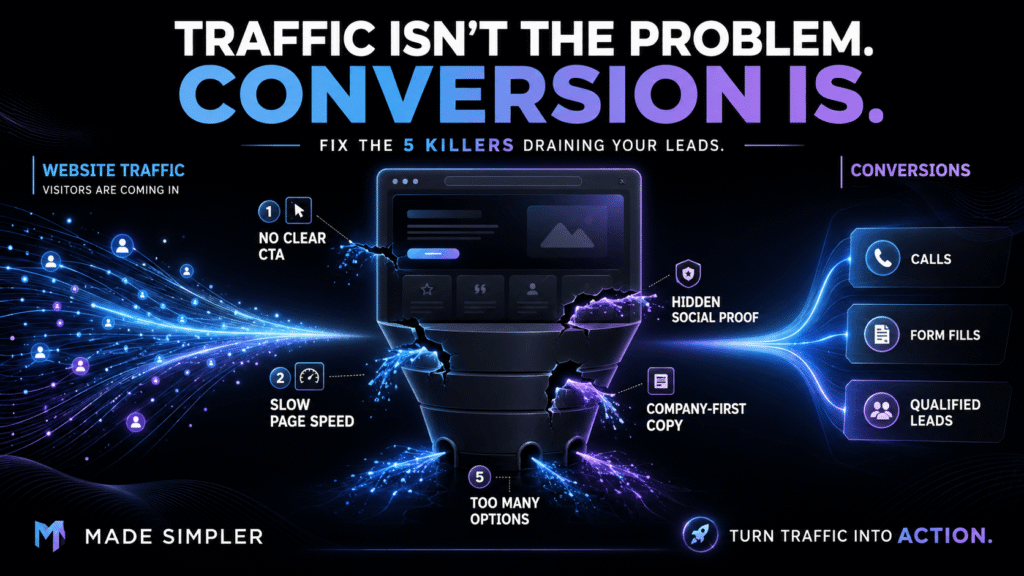
The Five Conversion Killers
1. No Clear Call to Action Above the Fold
The most common conversion failure: visitors land on your page and have no obvious next action. The call to action is below the fold, buried in navigation, or competing with three other equally prominent buttons. Every page needs one primary CTA visible without scrolling. One. Not three.
2. Slow Page Speed
A one-second delay in page load speed results in a 7% loss in conversions. On mobile, every second of delay can reduce conversions by up to 20%. When mobile page load time goes from one to three seconds, bounce probability increases by 32%. If your site takes more than 3 seconds to load on mobile, you’re losing a meaningful share of every visitor before they see your CTA.
3. No Social Proof Visible Without Scrolling
Testimonials, review stars, client logos, and case study results build trust before visitors commit to contacting you. If this content is at the bottom of the page — or on a separate “Testimonials” page most visitors never see — it’s not doing conversion work. 41% of consumers always read reviews before choosing a local business. Social proof above the fold shortens that research journey.
4. Copy That Talks About You, Not the Customer’s Problem
“We are a family-owned business serving the community since 1987.” “Our team of experts is dedicated to quality.” “We offer a wide range of services.” None of this answers the visitor’s actual question: “Can you solve my specific problem?” Pain-first copy leads with the customer’s problem, acknowledges it specifically, then positions your solution. Company-first copy leads with your history and accolades.
5. Too Many Options (Paradox of Choice)
Five CTAs, four service categories, three contact methods, two promotional banners. When visitors have too many choices, they make no choice. The highest-converting pages simplify ruthlessly: one message, one CTA, one obvious path to the next step.
| Problem | Fix | Expected Impact |
|---|---|---|
| No CTA above fold | Add primary CTA button in hero — one action, benefit-first label | 5–20% conversion lift |
| Slow page speed | Run Google PageSpeed Insights — fix LCP, compress images, remove unused plugins | 7–20% conversion lift per second recovered |
| No social proof above fold | Move best testimonial or review count to hero or just below | 10–30% trust signal improvement |
| Company-first copy | Rewrite hero with customer pain in first line, your solution in second | 15–40% engagement improvement |
| Too many CTAs | Audit every page — reduce to one primary CTA per page | Variable but consistently positive |
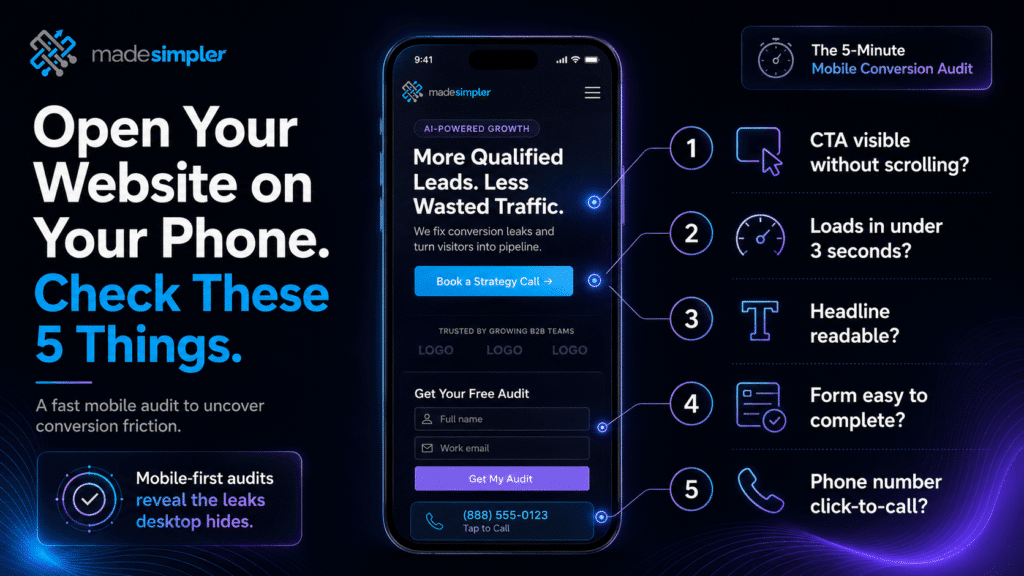
The Mobile-First Conversion Audit
Open your website on your phone — not your laptop. This is how the majority of your visitors experience it. Ask: Is the CTA visible without scrolling? Does it load in under 3 seconds? Can I read the headline without zooming? Is the contact form easy to complete on a touchscreen? Is the phone number click-to-call?
Most conversion problems are discovered in 5 minutes of this exercise. Most persist because the person responsible for the website only ever views it on a desktop.
→ Website design and conversion services
FREQUENTLY ASKED QUESTIONS
What’s a good website conversion rate?
Industry averages range from 1–4% across all industries. B2B professional services: 3–8%. SaaS free trial pages: 5–15%. Local service businesses: 2–5%. If your conversion rate is below 1%, you have a significant conversion problem. If it’s above 5%, you’re performing well. The baseline metric to track is conversions from traffic, not just traffic volume.
How much does page speed affect conversions?
A one-second delay in page load time causes a 7% drop in conversions. Pages that load in 1 second have 3× higher conversion rates than pages loading in 5 seconds. For most businesses, a day-long investment in page speed optimization produces conversion improvements that persist indefinitely.
Should I rebuild my website or optimize the existing one?
If the structure is sound (clear navigation, appropriate pages) but execution is weak (slow speed, poor copy, no social proof), optimization is faster and cheaper. If the architecture is fundamentally broken (no local pages, no service pages, no clear information hierarchy), a rebuild is the more efficient investment. The $297 Starter Audit typically determines which path makes sense.
Stop paying for marketing activity. Start paying for marketing results.
Made Simpler’s Rygen Lightning Build process designs conversion-first pages around the action you want visitors to take, then builds the shortest path to it.
About the Author
Ben Morrison | Founder of Made Simpler
Ben Morrison is the founder of Made Simpler, an organic content agency that helps businesses build sustainable traffic systems designed to survive algorithmic volatility.