

“Content marketing works.” Everyone says it. But when you ask “prove it,” most agencies pivot to impressions and pageviews. Content marketing ROI is measurable — but only if you build the attribution infrastructure before you start spending, not after you’re trying to justify the budget.
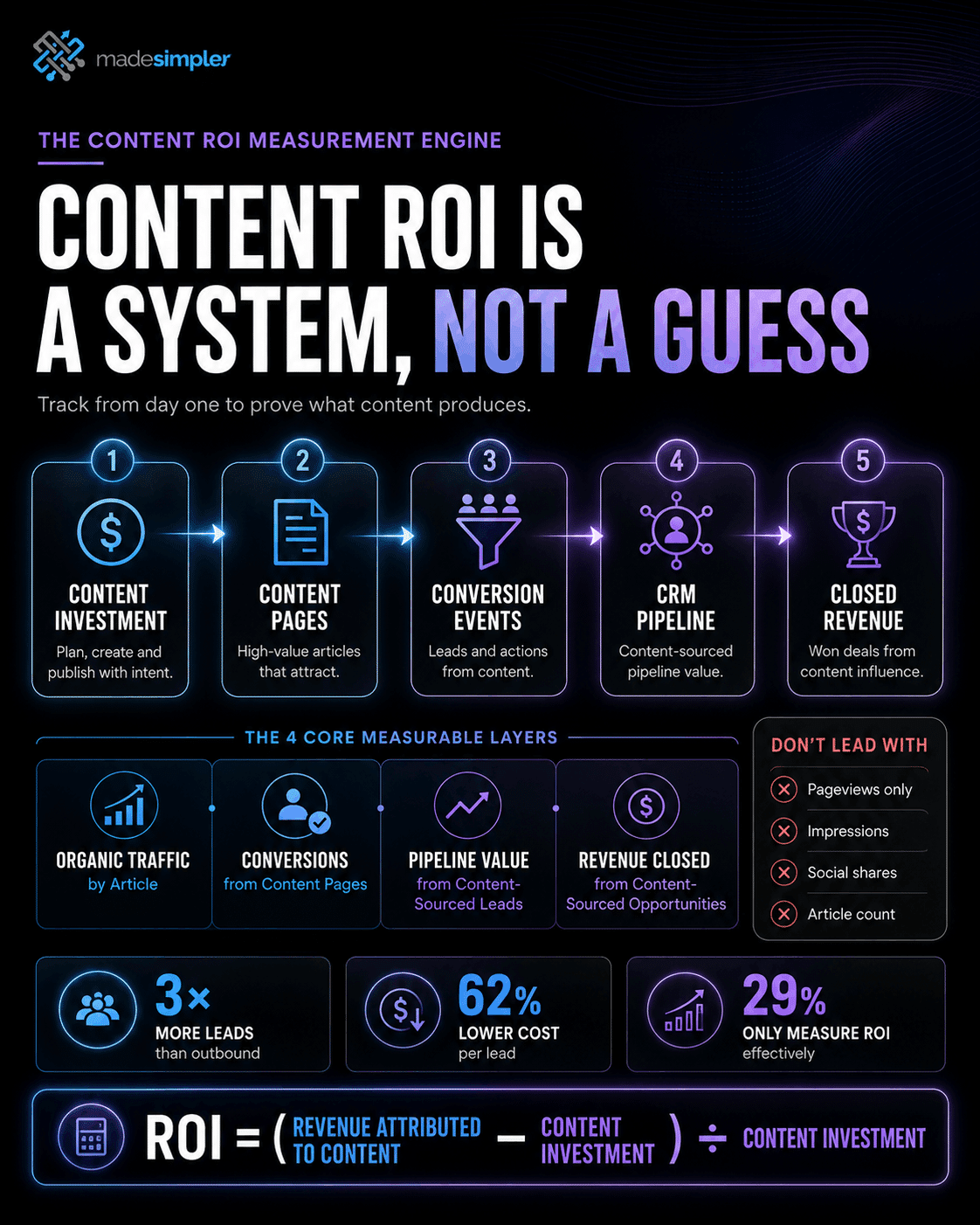
Here’s the framework we use with clients like PanTerra Networks (2,130% organic growth, 60+ qualified leads/month) and ClientTether (115+ articles, sustained ranking through multiple algorithm updates). It’s built on a simple foundation: content marketing generates over 3× as many leads as outbound marketing and costs 62% less — but only when the measurement infrastructure is in place to capture that performance.
The ROI Formula
(Revenue attributed to content – Content investment) ÷ Content investment = ROI percentage
Simple in theory. Executed poorly by most marketing teams. The two failure points: attributing revenue to content, and defining what counts as “content investment” completely
What to Track (The Metrics That Matter)
Organic Traffic by Article
Not just total site traffic — traffic by article, tracked in Google Search Console and Google Analytics 4. Which articles are driving sessions? Which are stagnant? Traffic distribution across your content is the diagnostic layer.
Conversion Events Attributed to Content Pages
Form submissions, phone calls, chat initiations, and demo requests that originate from content pages. GA4’s attribution modeling and UTM tracking make this traceable. If you’re not tracking conversions from content pages specifically, you’re flying blind.
Pipeline Value from Content-Sourced Leads
In your CRM, tag every lead with its first-touch and last-touch channel. Content-sourced leads (entered pipeline from an organic content page) should be tracked as a cohort. What’s their close rate? Average deal size? Time to close? This is the bridge between marketing metrics and revenue.
Revenue Closed from Content-Sourced Opportunities
The final attribution step: revenue closed from deals that originated with content. This number divided by your content investment gives you the true ROI percentage. PanTerra Networks’ content engine now produces 60+ qualified leads/month — the marginal cost of each new lead approaches zero as the library compounds.
What NOT to Track as Primary Metrics
- Pageviews without conversion data — traffic that doesn’t convert is not a business asset
- Social shares — social amplification is a secondary effect, not a primary ROI indicator
- Word count or article count — volume metrics measure activity, not outcome
- Impressions — awareness is valuable but not trackable to revenue without attribution
The industry has a measurement problem: only 29% of marketers measure content ROI effectively. This isn’t because measurement is impossible — it’s because most content programs are started without attribution infrastructure. The fix is a 2-hour setup investment before the first article is published.
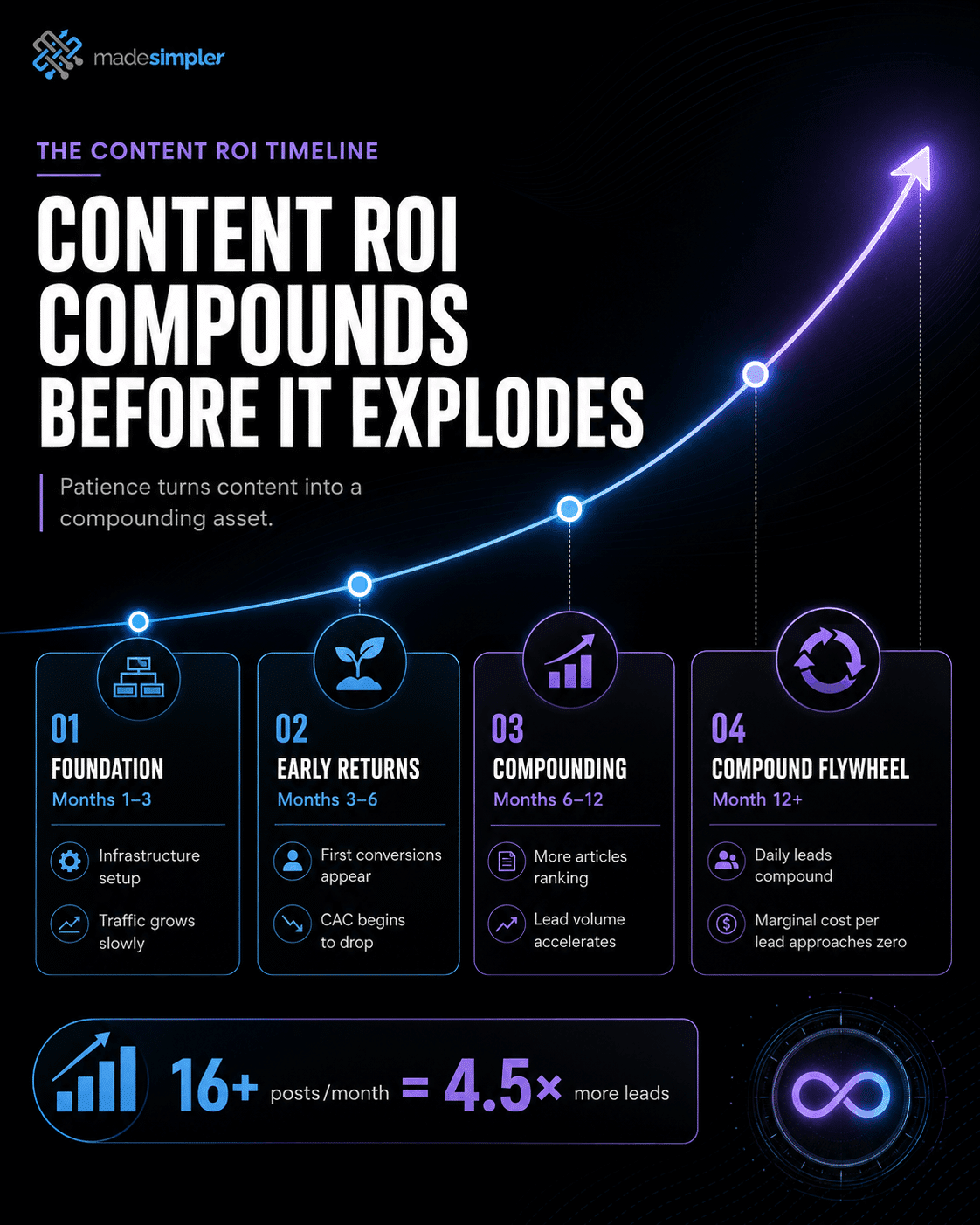
The Content ROI Timeline — Setting Honest Expectations
→ content cluster strategy for SLC tech companies
| Phase | Timeline | What’s Happening |
|---|---|---|
| Foundation | Months 1–3 | Investment exceeds visible return. Traffic growing slowly. Attribution infrastructure being validated. |
| Early Returns | Months 3–6 |
Organic traffic growing, first conversions appearing from content pages. CAC from content begins dropping below paid channels. |
| Compounding | Months 6–12 | Content clusters mature. Multiple articles ranking simultaneously. Lead volume growing faster than publishing cadence. |
| Compound Flywheel | Month 12+ | Marginal cost per lead approaching zero. Content library producing daily leads without proportional additional spend. |
The patience required in months 1–3 is why most content programs are abandoned before they produce returns. Companies publishing 16+ blog posts per month experience 4.5× more leads than infrequent publishers — but that lead advantage only materializes if the program runs long enough to compound.
→ Client results — PanTerra and ClientTether case studies
FREQUENTLY ASKED QUESTIONS
What’s a good content marketing ROI benchmark?
The average ROI for content marketing in 2025 is $7.65 per $1 spent. Well-executed SEO campaigns yield a median ROI of approximately 748%. The range is wide because execution quality and measurement rigor vary enormously. Businesses with proper attribution and consistent publishing cadence sit at the high end.
How long before content marketing pays for itself?
For most B2B programs: 6–9 months before revenue attribution is clearly visible; 12–18 months before the compound flywheel is undeniable. Content marketing is not a performance channel with 30-day payback cycles. It’s a compounding asset with a 3–5 year ROI horizon that outperforms paid media at scale.
→ AI search optimization guide
Can small businesses measure content ROI accurately?
Yes — with GA4, Google Search Console, and a CRM with basic lead source tracking. The minimum viable attribution stack is free. The missing ingredient for most small businesses is connecting CRM lead sources to closed revenue, which requires a 2-hour setup in any modern CRM.