
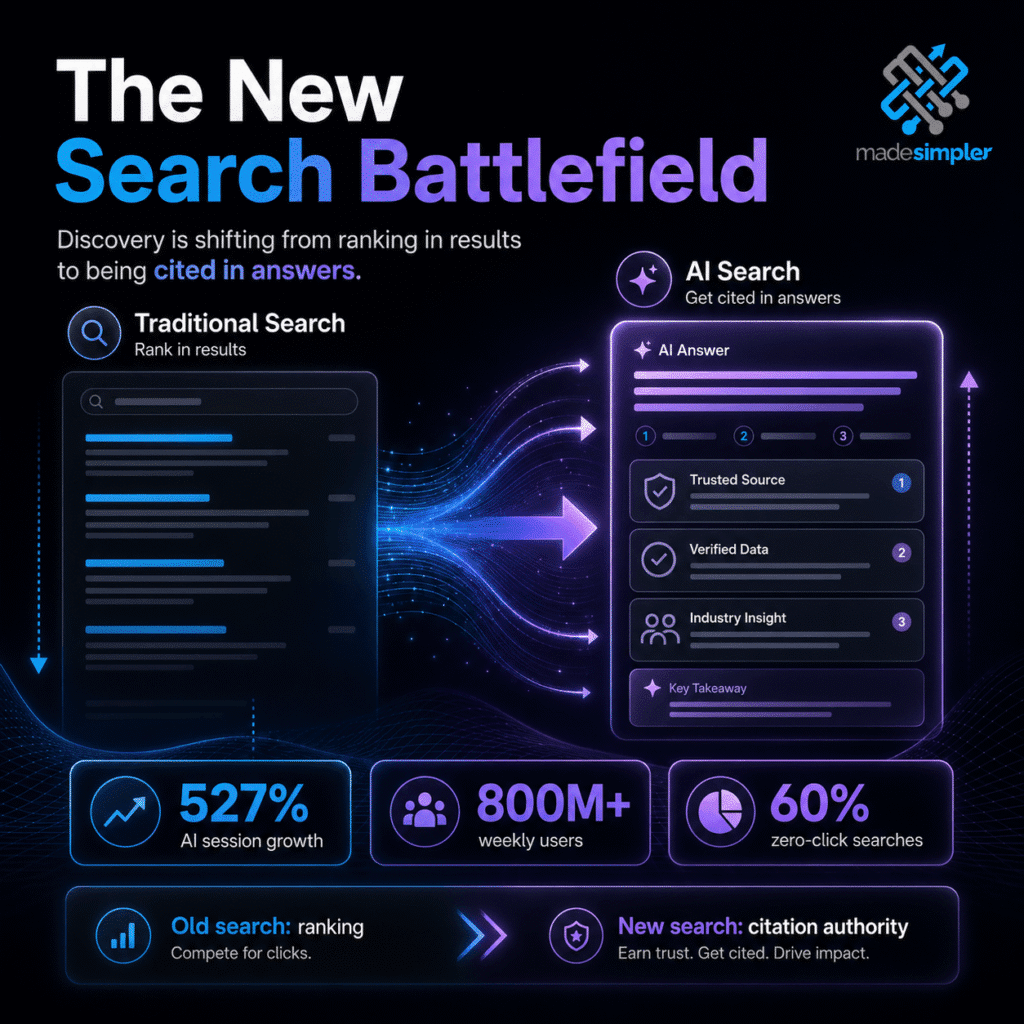
AI-referred sessions jumped 527% year-over-year in the first half of 2025. ChatGPT now reaches 800 million+ weekly users. Google AI Overviews appear in 13–16% of all searches. Nearly 60% of Google searches end without a click. The way people find businesses is changing — and most businesses aren’t optimized for where discovery is heading.
If your marketing strategy assumes everyone still clicks through Google’s ten blue links, you’re optimizing for a world that’s already changed. Here’s what AI search optimization is, why it matters now, and exactly how to do it.
→ AI search optimization services
What AI Search Means for Your Business
When someone asks ChatGPT “What’s the best marketing agency for small businesses?” or Perplexity “How do I choose a CRM?” the AI generates an answer that cites specific businesses and sources. Being one of those cited businesses is the 2026 equivalent of ranking #1 on Google — and the businesses building citation authority now are establishing advantages their competitors will struggle to replicate in 12–18 months.
The economic case is clear: being cited in AI-generated answers drives a 38% lift in organic clicks and a 39% increase in paid ad clicks. AI citations don’t replace traditional search — they amplify it.
GEO vs. SEO: The Difference That Matters
| Factor | Traditional SEO | GEO (Generative Engine Optimization) |
|---|---|---|
| Goal | Rank in search result pages | Be cited in AI-generated answers |
| Signal type | Keywords, backlinks, authority | Entity clarity, structured data, citation quality |
| Content format | Long-form, keyword-optimized | Answer-first, FAQ-structured, stat-rich |
| Timeline | 3–6 months to rank | 2–4 weeks for initial citation visibility |
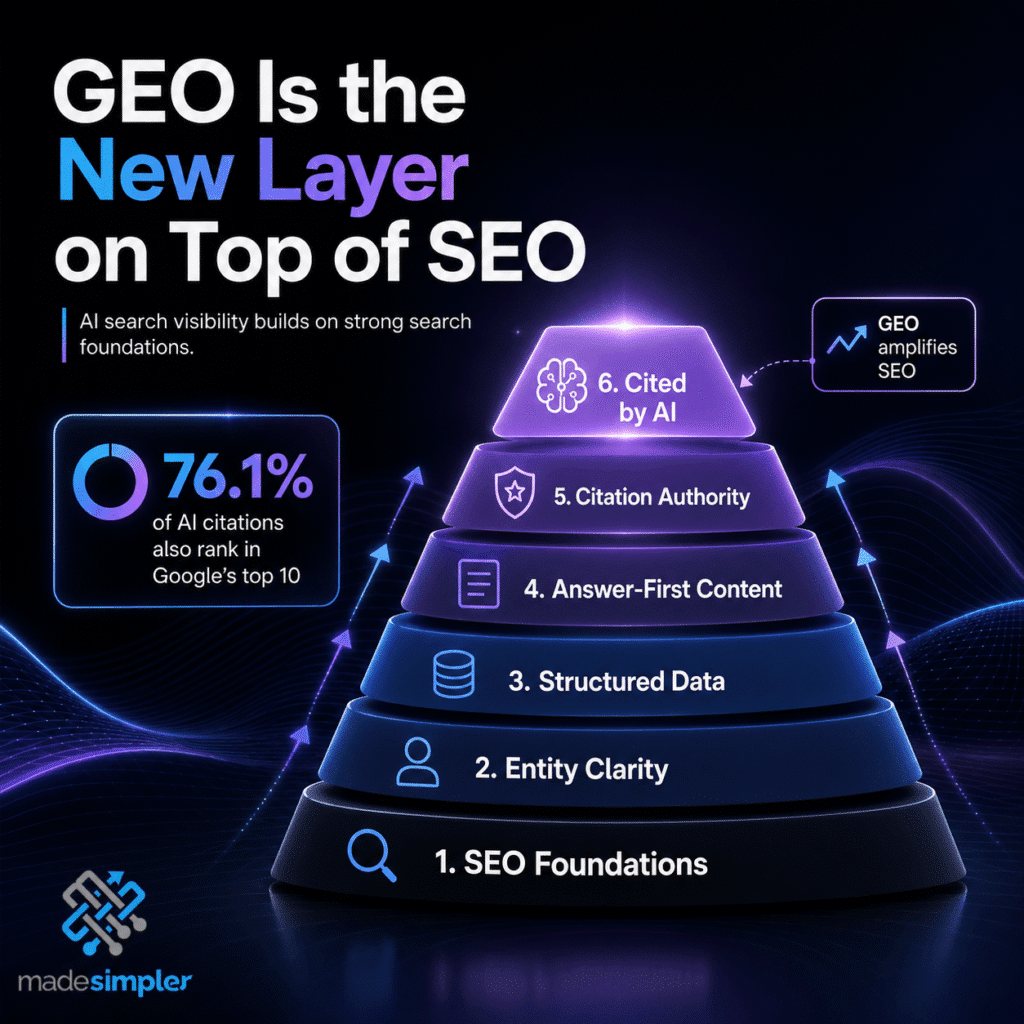
| Overlap | 76.1% of AI citations also rank in Google top 10 | High — strong SEO foundations support GEO |
The critical insight: GEO is not a replacement for SEO. It’s an additional layer. Strong SEO foundations directly support GEO success — the two are complementary, not competing.
How to Get Your Business Cited by AI
1. Answer-First Content Structure
AI systems extract the first clear, direct answer from your content. Lead every section with the direct answer in the first 1–2 sentences, then elaborate. This “BLUF” (Bottom Line Up Front) format is both readable for humans and extractable by AI.
2. FAQ Schemas on Every Page
Pages with valid FAQ and HowTo schema appear 20–30% more often in AI-generated summaries. FAQPage JSON-LD markup is the single highest-ROI technical investment for AI search visibility. It should be on every content page, service page, and local hub page.
3. Statistics and Citations in Body Content
The Princeton/Georgia Tech GEO research found that including statistics boosts AI visibility by +32% and citations by +30%. This isn’t about gaming the system — it’s about demonstrating the evidentiary quality that AI systems are trained to trust and cite.
4. Consistent Entity Data Across Platforms
→ Google Business Profile optimization — the foundation of AI entity authority
AI systems use entity resolution to verify business information across sources. Your business name, address, category, and description must be identical across Google, Yelp, LinkedIn, your website, and industry directories. Inconsistency signals unreliability and reduces citation probability.
5. Presence on Sources AI Cites Most
Reddit, LinkedIn, G2, industry publications, Wikipedia (where applicable), and review platforms are heavily cited by AI systems. A presence on these platforms — authentic, consistent, and active — feeds the citation networks that determine AI recommendations.
AI Search Optimization Checklist
→ how to measure the ROI of AI-optimized content
- Add FAQPage JSON-LD schema to every content page, service page, and local hub
- Rewrite section intros to lead with the direct answer in the first sentence
- Include at least one cited statistic per major section
- Audit entity consistency: same name, address, category across all platforms
- Build or update Google Business Profile with complete, consistent information
- Establish authentic presence on Reddit (for local businesses) and LinkedIn (for B2B)
- Add HowTo schema to any step-by-step content
- Review your content for keyword stuffing — AI systems deprioritize low-quality content
→ AI search optimization services
FREQUENTLY ASKED QUESTIONS
Is AI search optimization replacing traditional SEO?
No. 76.1% of AI Overview citations also rank in Google’s top 10. Strong SEO foundations directly support AI citation authority. GEO is an additional layer, not a replacement. Businesses that neglect traditional SEO in favor of GEO alone will lose both.
How quickly can AI search optimization produce results?
Initial citation visibility can appear within 2–4 weeks of implementing proper schema markup and content restructuring — faster than traditional SEO’s 3–6 month timeline. AI models update their knowledge more frequently than search engines recrawl the web. However, building sustained authority takes 6–12+ months of consistent content and entity building.
Do small local businesses need AI search optimization?
Yes — especially now, while competition is minimal. When someone asks ChatGPT “best dentist near me in Ogden Utah” or “top marketing agency Salt Lake City,” the AI pulls from structured content and entity signals. The local businesses building that authority now will be the default AI recommendations for years.
AI search is changing who gets found. Make sure it’s you.
Made Simpler builds AI search optimization into every content program — schema markup, answer-first structure, entity consistency, and the citation authority that makes AI systems trust and recommend your business.
About the Author
Ben Morrison | Founder, Made Simpler
Ben founded Made Simpler after walking away from a high-growth company whose revenue required treating people badly. Based in Layton, Utah. Author of The Great Google Shakedown.
→ How Made Simpler applies GEO for Ogden businesses